News
New Shepherds for Tradition: The Society of Saint Pius X Consecrate Four New Bishops
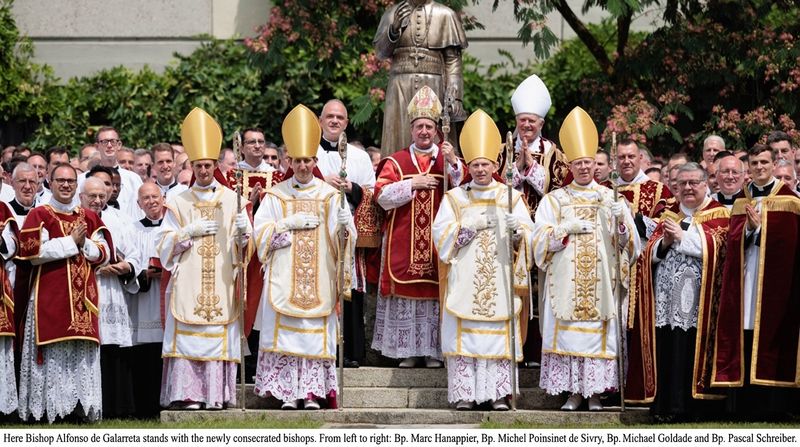
On the Feast of the Most Precious Blood, July 1, 2026, the Society of St. Pius X (SSPX) consecrated four new bishops at the society’s international seminary located in Écône, Switzerland, an event that saw more than 15,000 pilgrims.
In a ceremony lasting more than three hours, Bishops Pascal Schreiber (Switzerland), Michael Goldade (USA), Michel Poinsinet (France) and Marc Hanappier (France) were consecrated as auxiliary bishops (or bishops with no jurisdiction in a given diocese).
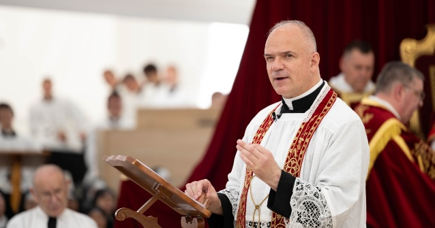 Fr. Pagliarani during the homily on July 1.
The decision to consecrate these bishops is justified by the Society as a “grave necessity.” Out of their original four bishops, consecrated in 1988 by Archbishop Marcel Lefebvre, only two are still alive, and both are, according to the Society, “do not suffice for the task” and that “the SSPX must equip itself to continue its apostolate, thereby responding to the pastoral needs of the faithful.”
The day before the consecrations were to take place, His Holiness Pope Leo XIV sent a letter to the Superior General of the SSPX, stating: “I plead with you and ask you with all my heart: please turn back!” Calling the consecrations a “schismatic act”, the Holy Father stated that “the Church is open to a path of dialogue and understanding that the Holy Spirit can make possible and fruitful.”
Fr. Pagliarani charitably answered, stating that the Society existed so that the “thousands of souls who have rediscover the Catholic Faith” might “attain salvation through this instrument which divine providence has placed at their disposal.” The priest concluded by asking the Holy Father to “please give us your blessing.”
Following the traditional Roman Pontifical, the Rite of Episcopal Consecration is celebrated within the Holy Sacrifice of the Mass, beginning after the Gradual and concluding before the Gospel.
At the beginning of the ceremony, the duties of the episcopal office are read to the bishops-elect, reminding them that “the bishop must judge, interpret, consecrate, ordain, offer sacrifice, baptize, and confirm.
Fr. Pagliarani gave the homily in which he explained that they were not carrying out these consecrations to separate themselves from the Church, but rather to assist the Church’s mission, adding that these bishops would in turn benefit the Church.
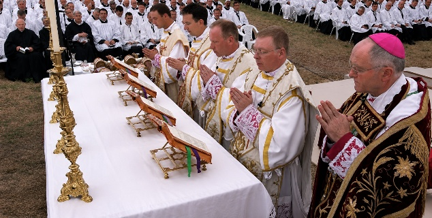 The new bishops, accompanied by Bishop Bernard Fellay, beginning the Holy Sacrifice of the Mass.
One of the most memorable moments of the rite was the offertory procession, seen only a handful of times in the past fifty years. The bishops-elect presented bread, candles, and barrels of wine bearing their coats of arms, symbolizing the gifts offered in the Holy Sacrifice of the Mass.
Following the Litany of the Saints, the principal consecrator and the co-consecrator imposed hands upon each bishop-elect, the essential matter of the sacrament. The Book of the Gospels was then placed upon each candidate's head and shoulders while the consecratory Preface—the sacramental form—was sung, conferring upon them the fullness of the priesthood.
With the rite complete, Holy Mass resumed, and the newly consecrated bishops received the Body and Blood of Christ from the same Host and chalice as the consecrating bishop, a fitting sign of the unity of the episcopate.